
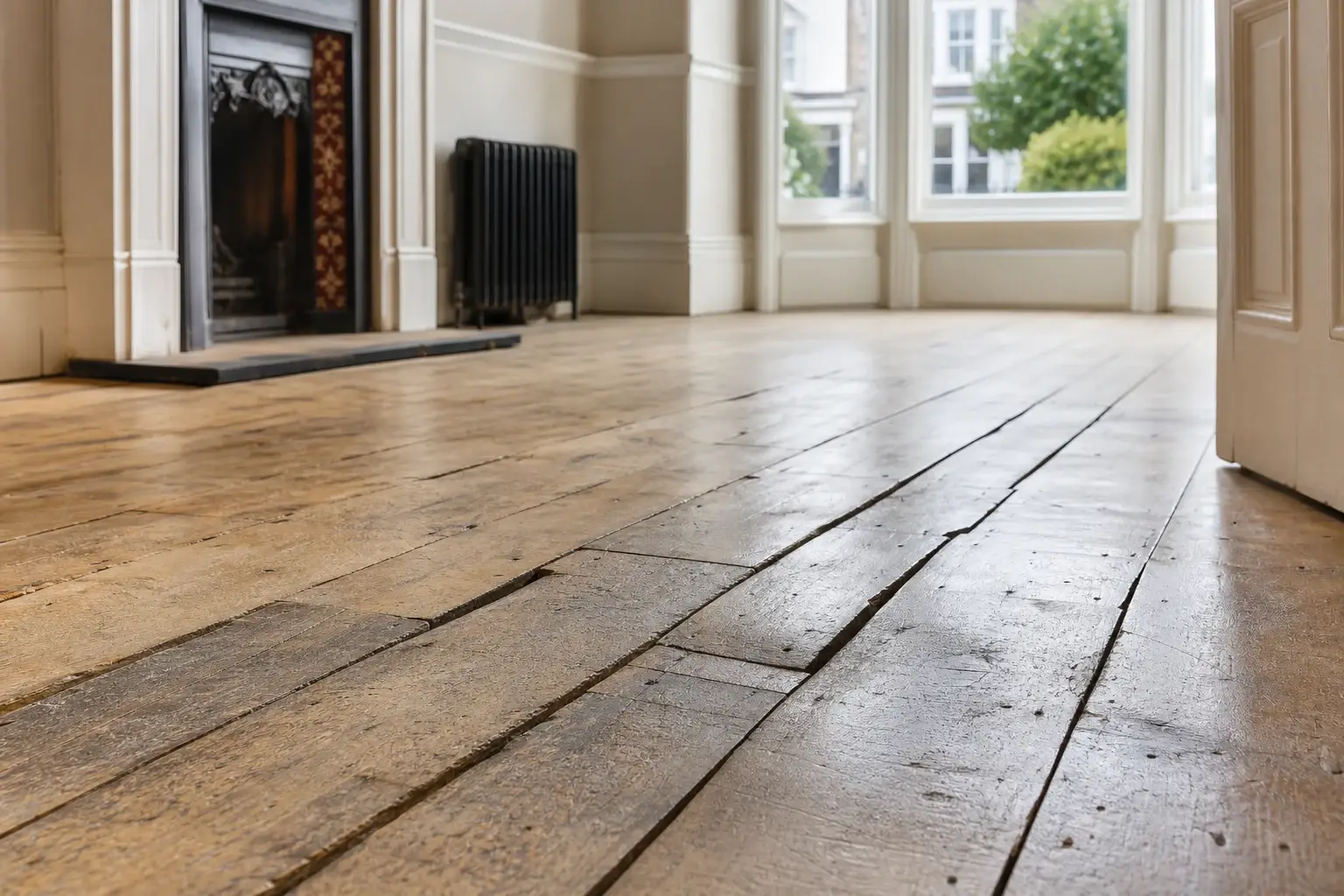
Period floorboards are rarely perfectly flat, perfectly sealed or perfectly silent. In Victorian, Edwardian and Georgian homes, a certain amount of movement, minor unevenness and seasonal gap changes is often part of the floor’s history. The question is not simply whether the boards feel tired underfoot, but what is causing that feeling and whether the floor is still performing as it should.
In older properties across Essex and London, original pine boards are often one of the most valuable surviving features. They can be full of character, but age, wear and later alterations can leave them feeling draughty, springy or uneven. Sometimes that is a normal consequence of a timber floor that has been in place for decades. Sometimes it is a sign that repair, re-fixing or selective replacement is needed.
Why period floorboards change over time
Wood is a natural material, so it moves. As floorboards dry out and respond to changes in temperature and humidity, they can shrink slightly, creating gaps between boards. That is especially common in older homes where the timber has been through many seasonal cycles. In a period property, those gaps do not always mean the floor is failing; they are often simply part of the way original boards behave.
Draughts usually become more noticeable where there are larger gaps, missing boards, open knot holes or spaces around the edges of the room. In some cases, the draught is not coming through the boards themselves but through the construction beneath them, particularly if the subfloor or void below is ventilated. That is why a specialist will usually look beyond the surface and assess the whole floor build-up before suggesting a solution.
Unevenness can come from several causes. Boards may have lifted slightly over time, fixings may have loosened, or the supporting joists beneath may have settled or moved. In older houses, especially those with previous renovations, floors are often a mix of original material and later repairs. That patchwork history can leave some sections more stable than others.
What the floor may be telling you
A floor that feels uneven underfoot does not automatically need replacing. In many cases, the issue is localised. A few loose boards may be squeaking because nails have worked up or fixings have failed. A section may feel bouncy if it is no longer sitting firmly on its supports. A worn surface may simply mean the original finish has been sanded back over the years and is now thin, patchy or absent in places.
Surface wear is different from structural movement. If the boards are sound but the finish has worn through, the floor may be a strong candidate for sanding and refinishing. If the boards are loose, split or badly damaged, repairs may need to come first. And if there are historic patches from previous work that no longer match the surrounding floor, selective board replacement can sometimes be the most practical way to restore a more even result.
It is also worth remembering that not every sign of age is a defect. Many homeowners like the slight irregularity of original floorboards because it suits the property. The aim is usually not to make a period floor look modern and machine-perfect, but to improve stability, comfort and appearance without removing its character.
When restoration is likely to help
Restoration tends to be most effective when the boards are still structurally sound and there is enough timber left to work with. That might include sanding away old coatings, repairing loose areas, filling gaps where appropriate and applying a finish that suits the room and the level of use. In hallways and landings, for example, floorboards often need a tougher finish than they do in a bedroom.
Where gaps are widespread, gap filling may help reduce draughts and improve the look of the floor, although it is not always suitable for every board layout or every property. A proper assessment matters, because filling every gap in an old timber floor is not always the right answer. Wood still needs to move naturally, and too much rigid filler in the wrong floor can create problems later.
If the surface is heavily worn, a professional restoration may also involve repair work before sanding begins. That is especially important where previous owners have used unsuitable fillers, over-nailed boards or covered sections with mismatched patches. A good result depends on preparation as much as on sanding itself.
If you want to understand the broader process, Touché Flooring explains what restoration includes and why careful preparation is central to the finished result.
When closer inspection is the wiser option
Some symptoms deserve more than a cosmetic response. If a floor has become noticeably springy, has sections that dip, or shows repeated movement in the same area, there may be an issue with the fixings or the support beneath. Dark staining, crumbling edges, severe splitting or signs of historic water damage can also change the repair approach. In those situations, restoring the surface alone may not solve the underlying problem.
Similarly, if a room has been altered over time and the boards seem to sit differently from one area to another, the cause may be old building work rather than the timber itself. That is common in period terraces, converted buildings and older houses where original floors have been cut around fireplaces, walls or earlier pipe routes.
For homeowners comparing repair with replacement, it can help to think in terms of condition rather than age alone. A floor can be old and still restorable. Another may look superficially similar but be too thin, too damaged or too patchy to justify further sanding. A specialist should be able to explain the difference clearly and recommend the most sensible route.
Original floorboards do not need to be perfect to be worthwhile. In the right condition, they can be repaired, stabilised and brought back into use without losing the qualities that make period flooring appealing in the first place.